Read Now
Getting your Trinity Audio player ready... |
Punjab History
Punjab Timeline
Here’s a timeline of Punjab’s history, covering key events and dates that shaped the region:
Ancient Punjab (Before 1st Century CE) of Punjab History
- c. 3300 – 1300 BCE: Indus Valley Civilization
Punjab was part of the Indus Valley Civilization, one of the world’s oldest urban cultures, with major sites like Harappa in present-day Punjab (Pakistan). - 1500 – 500 BCE: Vedic Period
After the decline of the Indus Valley Civilization, the Aryans migrated to the region, introducing the Vedic culture. Punjab, known as “Sapta Sindhu” (land of seven rivers), became a cradle of early Hinduism. - 326 BCE: Invasion of Alexander the Great
Alexander the Great invaded Punjab, defeating King Porus at the Battle of Hydaspes (Jhelum River). This was his furthest incursion into India before turning back. - 322 – 185 BCE: Maurya Empire
After Alexander’s retreat, Chandragupta Maurya founded the Maurya Empire, and Punjab became part of his kingdom. - 185 BCE – 320 CE: Indo-Greek and Kushan Rule
Following the collapse of the Maurya Empire, Indo-Greek and later Kushan rulers controlled Punjab, fostering trade and Buddhism.
Medieval Punjab (4th – 16th Century CE) of Punjab History
- 320 – 550 CE: Gupta Empire
The Gupta dynasty briefly held sway over Punjab, known as a golden age for arts and sciences in India. - 6th – 11th Century CE: Huns and Hindu Shahi Dynasty
After the fall of the Guptas, Punjab saw invasions by the Huns, followed by the establishment of the Hindu Shahi Dynasty, which ruled much of Punjab until the Muslim conquests. - 1001 CE: Mahmud of Ghazni’s Invasions
The Ghaznavid ruler Mahmud of Ghazni invaded Punjab, attacking important cities like Lahore and plundering Indian temples. - 1206 CE: Foundation of the Delhi Sultanate
After the Ghurid invasions, Punjab became a part of the Delhi Sultanate, with Lahore becoming an important administrative center. - 1398 CE: Timur’s Invasion
Timur (Tamerlane), the Mongol conqueror, invaded Punjab en route to Delhi, leaving destruction in his wake. - 1469 CE: Birth of Guru Nanak
Guru Nanak, the founder of Sikhism, was born in Nankana Sahib (now in Pakistan). His teachings laid the foundation for Sikhism, which originated in Punjab.
Mughal and Sikh Period (16th – 18th Century CE) of Punjab History
- 1526 CE: Beginning of Mughal Empire
Punjab came under Mughal control after Babur defeated Ibrahim Lodi at the Battle of Panipat. Lahore became one of the most important cities in the Mughal Empire. - 1604 CE: Compilation of the Guru Granth Sahib
Guru Arjan, the fifth Sikh Guru, compiled the Adi Granth, the holy scripture of Sikhism, which later became known as the Guru Granth Sahib. - 1675 CE: Execution of Guru Tegh Bahadur
The ninth Sikh Guru, Guru Tegh Bahadur, was executed by the Mughal Emperor Aurangzeb for resisting forced conversions of Hindus and Sikhs. - 1699 CE: Formation of the Khalsa
Guru Gobind Singh, the tenth and last Sikh Guru, established the Khalsa at Anandpur Sahib, formalizing the Sikh community as a martial and religious brotherhood. - 1708 CE: Death of Guru Gobind Singh
After Guru Gobind Singh’s assassination, the leadership of the Sikhs transitioned from human Gurus to the Guru Granth Sahib, marking the end of the line of living Sikh Gurus. - 1739 CE: Nadir Shah’s Invasion
Persian ruler Nadir Shah invaded Punjab and plundered Delhi, taking treasures like the Kohinoor diamond and causing devastation across the region.
Sikh Empire (18th – 19th Century CE) of Punjab History
- 1760s – 1799 CE: Rise of the Sikh Misls
After the decline of the Mughal Empire, Sikh warriors known as Misls (confederacies) emerged in Punjab, controlling various territories. - 1799 CE: Establishment of the Sikh Empire by Maharaja Ranjit Singh
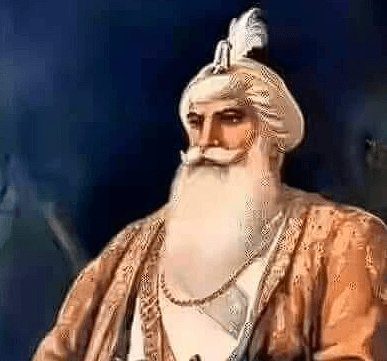
Maharaja Ranjit Singh unified the Sikh Misls and founded the Sikh Empire, with Lahore as its capital. His reign marked a period of peace and prosperity in Punjab. - 1839 CE: Death of Maharaja Ranjit Singh
The death of Ranjit Singh led to political instability and the eventual decline of the Sikh Empire. - 1845 – 1846 CE: First Anglo-Sikh War
Tensions between the Sikh Empire and the British East India Company culminated in the First Anglo-Sikh War, which resulted in a British victory and the loss of some Sikh territories. - 1849 CE: Second Anglo-Sikh War and Annexation of Punjab
After the Second Anglo-Sikh War, Punjab was formally annexed into British India. The Treaty of Lahore was signed, transferring the Kohinoor diamond and other treasures to the British Crown.
Colonial Punjab (19th – 20th Century) of Punjab History
- 1857 CE: Indian Rebellion
Punjab remained largely loyal to the British during the Indian Rebellion of 1857, and in return, the British invested heavily in infrastructure and education in the region. - 1907 CE: Punjab Peasant Uprising (Pagri Sambhal Jatta Movement)
Punjabi farmers, especially the Sikhs, protested against the British-imposed colonization policies and land laws, marking one of the early significant movements for farmers’ rights. - 1919 CE: Jallianwala Bagh Massacre
British troops under General Dyer fired on a peaceful gathering at Jallianwala Bagh in Amritsar, killing hundreds of unarmed civilians. This massacre galvanized the Indian independence movement. - 1920s – 1940s CE: Growth of Indian Independence Movement
Punjab played a crucial role in India’s freedom struggle, producing leaders like Lala Lajpat Rai and Bhagat Singh, whose contributions to the independence movement are celebrated widely.
Post-Independence Punjab (1947 – Present) of Punjab History
- 1947 CE: Partition of India
The partition of British India led to the division of Punjab into two parts—East Punjab in India and West Punjab in Pakistan. The partition triggered widespread violence, riots, and one of the largest mass migrations in human history, with millions displaced. - 1966 CE: Formation of Punjab as a Sikh-majority State
The Indian state of Punjab was further reorganized in 1966, with the Hindi-speaking regions carved out to form Haryana and Himachal Pradesh. Punjab became a predominantly Sikh-majority state. - 1960s – 1970s CE: Green Revolution
Punjab became the epicenter of the Green Revolution, which introduced new agricultural technologies, leading to a significant boost in crop production, especially wheat and rice. - 1990s CE: Militancy and Insurgency in Punjab
Punjab faced a period of insurgency, with demands for an independent Sikh state (Khalistan). - 2000s – Present: Economic and Cultural Renaissance
Post-insurgency, Punjab witnessed an economic resurgence, fueled by agriculture, industrialization, and an increasing diaspora presence. Punjabi music, cinema, and culture have gained global recognition, with cities like Ludhiana, Chandigarh, and Amritsar becoming centers of growth.
The history of Punjab is one of richness, resilience, and adaptation, marked by its contributions to religion, agriculture, and India’s independence movement. Despite periods of conflict and hardship, Punjab has emerged as a vital part of India and continues to play a crucial role in the country’s cultural and economic landscape.
History of Punjab: A Journey Through Time
Punjab, the land of five rivers—Beas, Sutlej, Ravi, Chenab, and Jhelum—has a rich and diverse history that stretches back thousands of years. Known as the gateway to the Indian subcontinent, Punjab has been a crucial region for ancient civilizations, powerful empires, religious movements, and modern politics. Its history reflects the evolution of India itself, from ancient times through medieval kingdoms to the colonial period and the struggle for independence. This narrative explores the history of Punjab in detail, traversing the centuries from ancient civilizations to the modern state.
Ancient Punjab (3300 BCE – 1200 CE)
Indus Valley Civilization (3300–1300 BCE)
Punjab’s history begins with the Indus Valley Civilization, one of the oldest urban cultures in the world. Major cities like Harappa and Mohenjo-Daro, located in modern-day Pakistan’s Punjab province, were part of this advanced civilization. It had a well-organized society with urban planning, brick houses, drainage systems, and agriculture. Harappa, one of the twin cities of the Indus Valley, was located near the Ravi River, playing a central role in early South Asian culture. The people of this civilization were engaged in trade with regions like Mesopotamia, and their culture laid the groundwork for future Indian civilizations.
Vedic Period (1500–500 BCE)
With the decline of the Indus Valley Civilization, the Aryans migrated to Punjab around 1500 BCE, marking the beginning of the Vedic period. This era saw the composition of the Rigveda, one of the oldest scriptures of Hinduism, which mentions Punjab as the land of seven rivers, or “Sapta Sindhu.” Punjab became the epicenter of early Vedic culture, where Indo-Aryan tribes established agricultural communities and developed religious rituals that would shape Indian society for millennia.
The Achaemenid Empire and Alexander’s Invasion (6th–4th Century BCE)
In the 6th century BCE, Punjab became part of the Achaemenid Empire under the Persian rulers Cyrus and Darius. It was during this period that Punjab came into contact with the wider world through trade and military campaigns.
In 326 BCE, Alexander the Great invaded Punjab after crossing the Indus River. His army engaged in the famous Battle of the Hydaspes (Jhelum River) against King Porus, a local ruler. Though victorious, Alexander was so impressed by Porus’ bravery that he allowed him to retain his kingdom. Alexander’s conquest, however, was short-lived, and after his departure, the region was ruled by local kingdoms.
Mauryan Empire (322–185 BCE)
After Alexander’s death, Punjab became part of the Maurya Empire, founded by Chandragupta Maurya. His grandson, Ashoka, one of India’s most famous rulers, embraced Buddhism and spread its influence throughout the region. Under the Mauryan rule, Punjab prospered economically and culturally, becoming a hub for trade and learning.
Post-Mauryan Period (185 BCE – 320 CE)
Following the decline of the Mauryan Empire, Punjab witnessed the rise of various smaller kingdoms and invasions by the Indo-Greeks, Scythians, and Parthians. During this time, Punjab was a crossroads for trade and culture, influencing the development of Hinduism and Buddhism in the region.
The Kushan Empire (1st–3rd Century CE) brought stability to Punjab, with rulers like Kanishka promoting Buddhism. The Gandhara School of Art flourished during this time, producing a unique blend of Greek, Persian, and Indian artistic traditions.
Medieval Punjab (320–1500 CE)
Gupta Empire (320–550 CE)
The Gupta Empire briefly controlled Punjab, marking a golden age in Indian history. Though the Guptas’ influence in Punjab was limited compared to their control over central India, they fostered trade and intellectual growth, with the region remaining a key link in the northern trade routes.
Hunas and the Hindu Shahi Dynasty (6th–11th Century CE)
Following the collapse of the Gupta Empire, Punjab was subject to invasions by the Hunas (or White Huns), who brought destruction to the region. However, in the 9th and 10th centuries, the Hindu Shahi Dynasty emerged as the dominant power in Punjab. The Shahis were Hindu kings who defended Punjab against multiple Muslim invasions and ruled until the 11th century when the Ghaznavid dynasty invaded.
Muslim Conquests and the Delhi Sultanate (11th–15th Century)
Punjab saw its first major Islamic invasion in 1001 CE, when Mahmud of Ghazni raided the region. Ghazni’s repeated invasions devastated much of northern India, including Punjab, but also established Islamic influence in the area.
By the early 13th century, Punjab became part of the Delhi Sultanate, an Islamic empire that ruled over much of northern India. The city of Lahore became an important administrative and cultural center during this period. Under the Delhi Sultanate, Punjab became a melting pot of Islamic, Hindu, and Buddhist influences.
Sikhism and the Mughal Period (16th – 18th Century)
Birth of Sikhism (1469–1708)
In 1469, Guru Nanak, the founder of Sikhism, was born in Nankana Sahib in Punjab. His teachings emphasized equality, monotheism, and social justice, rejecting the rigid caste system of Hinduism and the formalism of Islam. Guru Nanak’s message of universal love and harmony gained widespread followers, and the Sikh religion grew under the leadership of ten successive Gurus.
The fifth Guru, Guru Arjan Dev, compiled the Adi Granth, the holy scripture of Sikhism, in 1604. He was later executed by Mughal Emperor Jahangir, marking the beginning of a long-standing conflict between the Mughals and the Sikhs.
Mughal Rule (1526–1857)
Punjab became a key part of the Mughal Empire after Babur’s victory at the Battle of Panipat in 1526. Under Mughal rule, Lahore was one of the empire’s most important cities, often serving as a royal residence. The Mughal emperors Akbar and Jahangir were known for their architectural contributions to the region, including the construction of gardens and palaces in Lahore.
However, the Mughals’ relationship with the Sikhs deteriorated, especially under Aurangzeb, who executed the ninth Guru, Guru Tegh Bahadur, in 1675. In response, the tenth Guru, Guru Gobind Singh, militarized the Sikh community by founding the Khalsa in 1699, transforming Sikhs into a martial group to resist Mughal oppression.
The Rise of the Sikh Empire (18th Century)
Sikh Confederacy (1716–1799)
After Guru Gobind Singh’s death in 1708, Punjab experienced a power vacuum. The decline of Mughal power allowed the Sikh Misls (confederacies) to emerge, ruling different parts of Punjab. These Sikh rulers united to resist foreign invasions, notably from Afghan invader Ahmed Shah Abdali, who repeatedly plundered Punjab during the mid-18th century.
Maharaja Ranjit Singh and the Sikh Empire (1799–1849)
The most significant Sikh ruler was Maharaja Ranjit Singh, who unified the Sikh Misls and founded the Sikh Empire in 1799. Ranjit Singh established his capital in Lahore and created a powerful military state that successfully resisted both Afghan invasions and British expansion. His reign brought stability and prosperity to Punjab, with a flourishing economy, advancements in art, and religious tolerance.
Ranjit Singh’s death in 1839 led to political instability, and by 1849, after the two Anglo-Sikh wars, Punjab was annexed by the British East India Company.
Colonial Punjab (1849–1947)
British Rule (1849–1947)
The annexation of Punjab marked the beginning of British colonial rule, which had a profound impact on the region. The British introduced modern infrastructure, including railways, canals, and education systems. They also restructured agriculture, which laid the groundwork for Punjab’s later role in the Green Revolution.
However, British policies, especially concerning land taxes and the divide-and-rule strategy, led to widespread resentment among Punjabis. The Indian Rebellion of 1857 saw minimal participation from Punjab, as the British had cultivated local loyalty, particularly from the Sikh community.
The Jallianwala Bagh Massacre (1919)
Punjab played a central role in the Indian independence movement. The Jallianwala Bagh Massacre in Amritsar on April 13, 1919, was one of the most tragic events in Indian history, where British troops opened fire on a peaceful gathering, killing hundreds of unarmed civilians. This atrocity ignited nationalist sentiments across India and intensified calls for independence.
Role in the Freedom Struggle
Prominent leaders from Punjab, such as Lala Lajpat Rai and Bhagat Singh, became iconic figures in the struggle against British rule. Bhagat Singh, a revolutionary from Punjab, played a key role in the fight for independence and became a martyr after his execution in 1931.
**Partition and Modern Punjab (1947–Present)**
Partition of India (1947)
The partition of British India in 1947 resulted in the division of Punjab between India and Pakistan. The partition caused one of the largest and bloodiest migrations in human history, with millions of Sikhs and Hindus migrating from West Punjab (now in Pakistan) to East Punjab (India) and Muslims migrating in the opposite direction. The violence and mass displacement left deep scars on both sides of the border.
Post-Partition Punjab
After independence, East Punjab in India was reorganized in 1966, leading to the creation of Haryana and Himachal Pradesh. Punjab, as we know it today, became a Sikh-majority state.
The Green Revolution (1960s–1970s)
In the 1960s, Punjab became the epicenter of India’s Green Revolution, which introduced high-yield variety seeds, chemical fertilizers, and modern irrigation techniques. This transformed Punjab into India’s breadbasket, making it a leading producer of wheat and rice.
Operation Blue Star (1984) and Aftermath
The 1980s were a turbulent period in Punjab’s history due to demands for greater autonomy and the rise of the Khalistan movement.
Modern Punjab
Since the 1990s, Punjab has experienced relative peace and economic growth. Its agriculture-based economy has expanded to include industries like textiles, tourism, and information technology. Punjabi culture, particularly its music, film industry, and diaspora, has gained global recognition.
Conclusion
The history of Punjab is one of resilience, adaptation, and transformation. From its early days as a center of ancient civilizations to its role in shaping the religious and political landscape of India, Punjab has been a dynamic and influential region. Despite the challenges of invasions, colonialism, partition, and internal strife, Punjab continues to thrive as a cultural and economic hub in modern India.
FAQs
- What is the earliest known civilization in Punjab?
- The earliest known civilization in Punjab is the Indus Valley Civilization, which dates back to around 3300 BCE.
- When did the Aryans arrive in Punjab?
- The Aryans are believed to have arrived in Punjab around 1500 BCE during the Vedic period.
- What was the significance of the Battle of the Hydaspes?
- The Battle of the Hydaspes in 326 BCE was fought between Alexander the Great and King Porus. It marked Alexander’s entry into the Indian subcontinent.
- Which empire first unified Punjab under a single rule?
- The Maurya Empire, under Chandragupta Maurya, unified Punjab around 322 BCE.
- When did the Gupta Empire rule Punjab?
- The Gupta Empire ruled Punjab from around 320 to 550 CE.
- Who were the first Muslims to conquer parts of Punjab?
- The Arabs, led by Muhammad bin Qasim, first conquered parts of Punjab in 712 CE.
- What was the impact of Mahmud of Ghazni on Punjab?
- Mahmud of Ghazni invaded Punjab multiple times between 1000 and 1027 CE, establishing Muslim rule in the region.
- When did the Delhi Sultanate control Punjab?
- The Delhi Sultanate controlled Punjab from the early 13th century until the early 16th century.
- What was the significance of the Sikh Empire in Punjab?
- The Sikh Empire, established by Maharaja Ranjit Singh in 1799, unified Punjab and expanded its territory significantly until its fall in 1849.
- When did Punjab become part of the British Empire?
- Punjab became part of the British Empire in 1849 after the defeat of the Sikh Empire.
- What was the Jallianwala Bagh Massacre?
- The Jallianwala Bagh Massacre occurred on April 13, 1919, when British troops fired on a peaceful gathering in Amritsar, killing hundreds.
- How did the partition of India affect Punjab?
- The partition of India in 1947 split Punjab between India and Pakistan, leading to massive migrations and violence.
- What is the significance of the Green Revolution in Punjab?
- The Green Revolution in the 1960s and 70s transformed Punjab into India’s breadbasket, significantly increasing agricultural productivity.
- When was the state of Punjab reorganized in India?
- The state of Punjab was reorganized in 1966, leading to the creation of Haryana and Himachal Pradesh.
- What are some key cultural contributions of Punjab?
- Punjab is known for its rich cultural heritage, including Bhangra music and dance, Punjabi cuisine, and festivals like Baisakhi.
- Who are some famous historical figures from Punjab?
- Famous historical figures include Maharaja Ranjit Singh, Bhagat Singh, and Guru Nanak Dev Ji.
- What role did Punjab play in India’s independence movement?
- Punjab played a crucial role in India’s independence movement, with many freedom fighters and significant events like the Jallianwala Bagh Massacre.
- How has Punjab evolved in the post-independence era?
- Post-independence, Punjab has developed economically and culturally, becoming a major agricultural and industrial hub in India.
Punjab History
Punjab History
Punjab History
Punjab History
Punjab History
Punjab History
Punjab History
Punjab History
Punjab History
Punjab History
Punjab History
Punjab History
Punjab History
Punjab History
Punjab History
Punjab History
Punjab History
Punjab History
Punjab History
Punjab History
Punjab History
Punjab History
Punjab History
Punjab History
Punjab History
Punjab History