Read Now
Getting your Trinity Audio player ready... |
Kabaddi 25 Facts, Rules, Game, History, Players, Teams
25 Fascinating Facts about Punjabi Sport Kabaddi
- Origin in Punjab: It has deep roots in Punjab, India, where it evolved as a traditional sport that combines elements of strength, strategy, and agility.
- Ancient History: It is believed to date back over 4,000 years, originally practiced as a way for warriors to build stamina, improve reflexes, and increase physical strength.
- Meaning of the Name: The name “Kabaddi” likely comes from the word “Kaunbadi,” a Tamil word meaning “holding hands,” symbolizing teamwork and the traditional hand-holding technique in the game.
- Cultural Importance: It is an integral part of Punjabi culture, played in villages, schools, and during local festivals as a way to celebrate Punjab’s heritage of athleticism.
- Two Main Styles: The sport has two main styles – Circle Style (played mainly in Punjab and Canada) and Standard Style (internationally recognized and played in leagues like the Pro Kabaddi League).
- Simple Rules, High Intensity: It is a simple game, with one player (raider) trying to tag as many opponents as possible while holding their breath. However, the rules require players to be skilled, strategic, and highly agile.
- Holding the Breath: The raider must chant “Kabaddi” continuously to prove they are holding their breath while trying to tag opponents, adding an element of endurance to the sport.
- Popular Worldwide: Although rooted in Punjab, It is popular in other countries, particularly where there are large Punjabi communities like Canada, the UK, and the USA.
- Recognition by the International Kabaddi Federation (IKF): The IKF was founded in 2004 to promote the sport globally and set standardized rules, bringing formal structure to the game.
- Kabaddi World Cup: The Kabaddi World Cup is a major international tournament. India has dominated the competition, with the Indian team often including a large number of Punjabi players.
- Pro Kabaddi League (PKL): Launched in 2014, the Pro Kabaddi League brought international attention to the sport, with Punjab contributing a large number of skilled players.
- Dhol and Bhangra: Traditional Punjabi dhol music and Bhangra performances often accompany matches in Punjab, creating a vibrant and celebratory atmosphere.
- Prominent Punjabi Players: Punjab has produced many iconic players, including Maninder Singh, Pardeep Narwal, and Ajay Thakur, who are celebrated both domestically and internationally.
- NRI Influence: Non-resident Indians (NRIs), especially in Canada, have established clubs and leagues, keeping the sport alive and thriving outside India.
- Circle Style Kabaddi Tournaments: In Punjab, Circle Style Kabaddi tournaments are common, often attracting thousands of spectators and involving cash prizes.
- Kabaddi Federation of India (KFI): The KFI was established in 1950 to promote Kabaddi across India, including the Standard Style format, which is now popular internationally.
- Recognition by Asian Games: Kabaddi was introduced as a medal sport in the Asian Games in 1990, with India consistently winning gold, further elevating the sport’s popularity.
- Equipment: Kabaddi is often played without any equipment, but Standard Style requires a mat. Circle Style matches in Punjab are typically played on a dirt field.
- Simplicity in Uniform: Players traditionally wear simple, often sleeveless attire, representing the rural roots of the sport.
- Kabaddi in Schools: In Punjab, It is encouraged in schools, and many villages have training camps for young players, supporting the next generation of players.
- Punjabi Film Influence: Punjabi cinema has highlighted It in movies like “Kabaddi Once Again” and “Harjeeta,” reflecting the sport’s cultural significance.
- Importance of Body Control: Players are known for their impressive body control and agility, with special techniques like ankle holds, kicks, and dives.
- Kabaddi Coach Role: In Punjab, there are experienced coaches who train players on raiding techniques, defense formations, and stamina-building exercises.
- International Kabaddi Tournaments in Punjab: Punjab hosts annual international tournaments with teams from Canada, Pakistan, and England, promoting cross-cultural ties.
- Representation in Republic Day Parade: Players from Punjab have represented the sport during India’s Republic Day celebrations, showcasing it as a source of national pride.
It is a sport deeply intertwined with Punjabi heritage, stands as one of India’s most beloved and culturally significant sports. With roots dating back thousands of years, it is more than just a physical game; It represents a way of life, a celebration of strength, strategy, and community. This sport, with its simple rules and complex techniques, has evolved from village competitions in Punjab to an internationally recognized game, attracting fans and players from across the globe.
Below, we delve into the origin, history, gameplay, cultural significance, and evolution of sport, examining why it holds such a revered place in Punjabi and Indian culture.
Origins and History of Kabaddi
Its roots can be traced back over 4,000 years, making it one of the oldest sports in Indian history. It is believed to have originated in ancient India, particularly in the northwestern regions, which are now part of modern-day Punjab and Haryana. Some historians suggest that the sport developed as a training exercise for soldiers, helping them improve stamina, quick reflexes, and tactical skills in hand-to-hand combat. The game’s essence lies in the players’ ability to attack and defend, simulating battlefield strategies.
In ancient Punjab, It was a popular sport during harvest festivals like Baisakhi, celebrated with enthusiasm by both players and spectators. As the sport gained traction, local competitions emerged in rural areas, drawing people together and building a sense of community. Villages often competed against each other, and its matches became a highlight of the social calendar.
The Unique Rules and Gameplay of Kabaddi
It is a contact sport played between two teams, each aiming to outscore the other. The game’s primary components involve one player from a team, known as the “raider,” attempting to tag members of the opposing team and return to their side of the court without being caught. Meanwhile, the defending team tries to tackle the raider to prevent them from scoring.
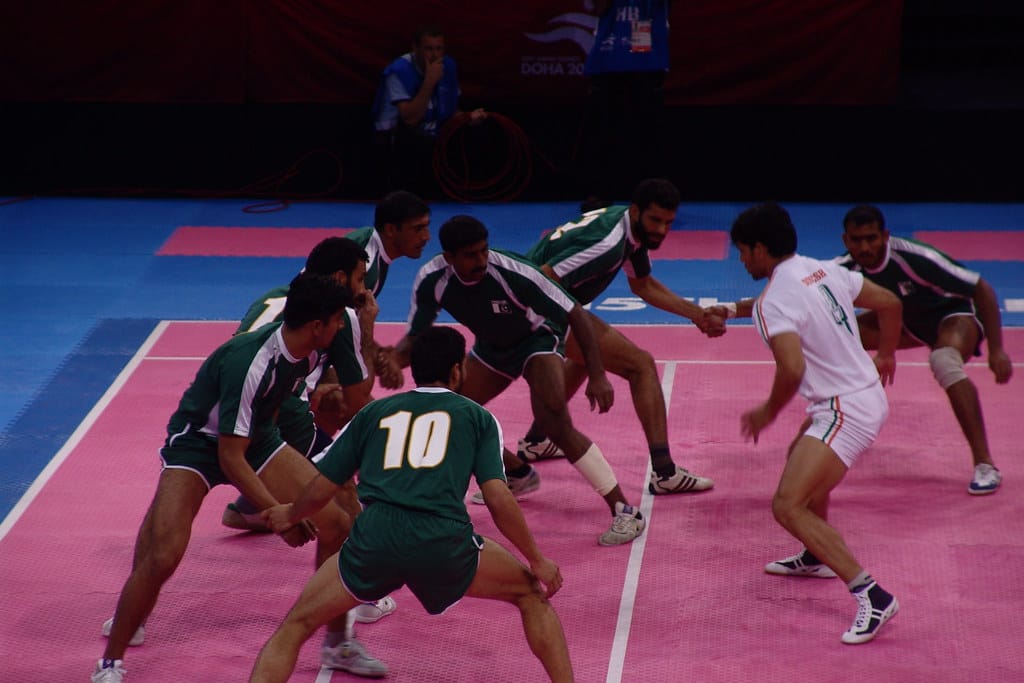
Basic Rules
- Raid and Chanting “Kabaddi”: The raider enters the opponent’s half and must tag as many defenders as possible while continuously chanting “Kabaddi.” This chant proves that they are holding their breath throughout the raid, adding an element of stamina and endurance to the game.
- Tackling the Raider: The defenders, or the opposing team, aim to prevent the raider from returning to their own side. They attempt to tackle or wrestle the raider to the ground without breaking the rules of contact. If successful, they score a point.
- Points and Scoring: Points are scored in two ways. The raider earns points by tagging defenders and successfully returning, while defenders earn points by preventing the raider’s escape.
- Elimination and Revival: If a player is tackled or tagged, they are temporarily eliminated from the game. Players are revived upon scoring, allowing the game to shift momentum quickly.
The game requires a balance of mental acuity, agility, strength, and teamwork. These elements make a thrilling and strategic sport, loved for its simple rules but complex gameplay.
Cultural Significance in Punjab
In Punjab, It has a cultural status that transcends sports. It embodies the values of courage, resilience, and community—qualities that resonate with Punjabis. Many traditional festivals and fairs in Punjab feature tournaments, creating an environment that celebrates the region’s rich athleticism and sportsmanship. Punjabi villages often host matches, drawing large crowds from surrounding areas, where participants display their skills in front of passionate fans.
The dhol (a traditional Punjabi drum) and bhangra dancers accompany these matches, creating a lively atmosphere that mirrors the enthusiasm of the players. It has become a symbol of Punjabi identity, representing the vigor, unity, and pride of the Punjabi people.
Different Styles of Kabaddi: Standard and Circle
While It may have a universal appeal, it is played in two main styles: Standard Style and Circle Style. Each version is unique, with variations in rules and playing field dimensions.
- Standard Style: This style is recognized internationally and follows rules set by the International Kabaddi Federation (IKF). Standard Kabaddi is played on a rectangular mat with seven players on each team. The game is structured with two halves, each lasting 20 minutes, with a short break in between.
- Circle Style: Originating from Punjab, Circle is the traditional form, often played outdoors on a circular field. This style does not have a fixed team size, and the game’s rules can vary depending on local traditions. Circle matches are fast-paced, with fewer formal rules than Standard Style, making it popular at local festivals and rural competitions.
In Punjab, Circle Style is particularly cherished for its rustic appeal and minimalistic requirements. It is often played barefoot on a dirt field, allowing players to connect more naturally with the game. Circle Style is more common in rural areas, with the community gathering around to cheer on local teams.
Kabaddi on the Global Stage
It has gained global recognition, largely due to the efforts of Punjabi communities abroad and international sporting bodies. The establishment of the International Kabaddi Federation (IKF) in 2004 helped standardize the rules and promote the game on a global scale. The IKF introduced structured tournaments like the Kabaddi World Cup, held in both Standard and Circle styles, where teams from countries like Canada, Iran, South Korea, and the United States participate.
India, and particularly Punjab, has consistently performed well in international Its events, with Indian teams often winning titles and setting records. Indian players have become international icons, and Punjab has produced several renowned players such as Ajay Thakur, Maninder Singh, and Pardeep Narwal, whose skills have captivated fans worldwide.
Punjabi expatriates, especially in Canada, the UK, and the US, have been instrumental in popularizing It. They have established Kabaddi clubs, leagues, and tournaments, ensuring the sport remains alive and thriving outside India.
The Pro Kabaddi League and Kabaddi’s Modern Popularity
The launch of the Pro Kabaddi League (PKL) in 2014 revolutionized the sport, bringing Kabaddi into the mainstream sports entertainment industry. Inspired by the success of the Indian Premier League (IPL) in cricket, the PKL has become a huge success, attracting millions of viewers across India and internationally.
The PKL has brought in teams representing major Indian cities, featuring top players, including many from Punjab. This league has professionalized sport, introducing aspects like live television broadcasting, player auctions, and celebrity endorsements. The popularity of PKL has changed the perception from a rural pastime to a competitive sport with a dedicated fanbase.
Popular Kabaddi Teams
- Patna Pirates
- Bengal Warriors
- U Mumba
- Jaipur Pink Panthers
- Tamil Thalaivas
- Haryana Steelers
- Gujarat Giants
- Bengaluru Bulls
- Dabang Delhi KC
- Puneri Paltan
Popular Kabaddi Players
- Pardeep Narwal – “Dubki King”
- Ajay Thakur – Former Indian team captain
- Anup Kumar – “Captain Cool”
- Rahul Chaudhari – “Raid Machine”
- Maninder Singh – Bengal Warriors captain
- Deepak Niwas Hooda – All-rounder for Jaipur Pink Panthers
- Rohit Kumar – Raider for Bengaluru Bulls
- Fazel Atrachali – Top defender from Iran
- Sandeep Narwal – All-rounder known for powerful tackles
- Nitin Tomar – Known for his raiding skills
These teams and players have become household names through their skills, records, and contributions to popularizing sport.
Training and Development Programs in Punjab
With gaining international acclaim, Punjab has taken proactive steps to nurture future talent. Various training centers, schools, and academies have been established across the state, providing young athletes with professional training and resources. These programs focus on developing physical strength, agility, and mental strategies while instilling the values of sportsmanship and discipline.
In addition to school and college teams, its coaching centers are becoming common, especially in villages, where local coaches train young players in raiding, defending techniques, and stamina-building exercises. These initiatives have helped foster a new generation of Its players who are equipped to compete at both national and international levels.
Women in Kabaddi
While traditionally dominated by men, It has seen a rising number of female players in recent years. Punjabi women have shown tremendous potential and are breaking stereotypes, proving that It is not restricted to any gender. Tournaments, both locally and nationally, are increasingly featuring women’s teams. The Women’s Kabaddi Challenge and the inclusion of It in the Asian Games have further propelled the popularity of women’s sport, inspiring young girls across Punjab to pursue the sport.
Kabaddi in Punjabi Media and Popular Culture
It has left a significant impact on Punjabi media and entertainment. Punjabi cinema and music have highlighted Kabaddi in numerous ways, portraying it as a sport of valor and pride. Films like Kabaddi Once Again and Harjeeta showcase the game’s significance and its role in Punjabi identity, bringing the essence of the sport to a wider audience.
Punjabi songs celebrating sport have become popular, reflecting the sport’s influence on the state’s cultural landscape. This presence in media reinforces its image as a symbol of resilience and strength.
Challenges and Future of Kabaddi
While It enjoys significant popularity, also faces challenges. The sport must continue evolving to maintain its appeal to younger generations and keep up with global trends in sports. Moreover, professional players often have shorter career spans due to the intense physicality of the game, and better support systems are needed to provide these athletes with security and medical care.
Looking forward, technological advancements like AI-based training and analytics could further refine players’ techniques and help It keep up with the professional standards of other global sports. Increased government support and sponsorship could provide the necessary funding and facilities, especially for rural areas.
The future lies in balancing tradition with innovation. While the sport maintains its traditional charm in Punjab, there is a need for structured leagues, improved training, and international exposure to ensure It continues to thrive on a global level.
Conclusion
Its is more than just a game in Punjab; it is an embodiment of the region’s spirit and culture. From its ancient roots to its current status as an internationally recognized sport, It has journeyed through centuries, adapting and growing while retaining its core values of strength, endurance, and community.
FAQs
- What is Kabaddi?
- It is a contact sport that originated in the Punjab region of India, involving two teams of seven players each.
- How is Kabaddi played?
- One player from each team, called the “raider,” runs into the opposing team’s half of the court, attempting to tag as many opponents as possible and return to their own half without being tackled.
- What is the objective of Kabaddi?
- The objective is to score points by tagging opponents and returning to one’s own half without being caught.
- How many players are there in a Kabaddi team?
- Each team consists of seven players on the court and four substitutes.
- What is the playing area for Kabaddi?
- It is played on a rectangular court, measuring 13 meters by 10 meters, with a midline dividing the two halves.
- What is the duration of a Kabaddi match?
- A standard match consists of two halves of 20 minutes each, with a 5-minute break in between.
- What is the significance of the chant “Kabaddi, Kabaddi” during a raid?
- The raider must chant “Kabaddi, Kabaddi” continuously while in the opponent’s half to prove that they are not out of breath and are not stalling.
- What happens if the raider is caught by the defenders?
- If the raider is caught, they are out, and the opposing team earns a point.
- What are the main skills required for Kabaddi?
- Key skills include strength, agility, speed, endurance, and teamwork.
- What are the different variations of Kabaddi?
- Variations include Circle Style, Sanjeevani and Goongi each with unique rules and playing styles.
- What is the role of the “stoppers” in Kabaddi?
- Stoppers are defenders who try to stop the raider from tagging them and returning to their own half.
- How is a Kabaddi match officiated?
- A match is officiated by a referee who ensures that the rules are followed and makes decisions on fouls and points.
- What is the significance of Kabaddi in Punjabi culture?
- Kabaddi is deeply rooted in Punjabi culture, often played during festivals and community events, symbolizing strength and unity.
- What is the history of Kabaddi?
- It has ancient origins, with references found in ancient texts and it has evolved over centuries to become a popular sport in India and other countries.
- What is the Pro Kabaddi League (PKL)?
- The Pro Kabaddi League is a professional kabaddi league in India, launched in 2014, featuring teams from various cities competing in a structured tournament.
- How has Kabaddi gained international recognition?
- It has gained international recognition through events like the Kabaddi World Cup and its inclusion in multi-sport events like the Asian Games.
- What are the health benefits of playing Kabaddi?
- Playing It improves physical fitness, agility, strength, and mental alertness.
- What is the role of the coach in a Kabaddi team?
- The coach trains the team, devises strategies, and ensures players are in peak physical condition.
- What is the role of the fans in Kabaddi matches?
- Fans provide support, create a lively atmosphere, and help popularize the sport.
- What is the future of Kabaddi?
- The future looks promising with increasing professional leagues, international competitions, and growing youth participation.